
Yoakum Parole and Probation
Parole and probation answer different questions about a released person. The Texas Department of Criminal Justice Parole Division supervises people released from state prison on parole or mandatory supervision. The Texas Board of Pardons and Paroles makes the release decision. A Yoakum County court, by contrast, imposes probation under Code of Criminal Procedure Chapter 42A. The community-supervision and corrections department serving that court administers the term. A bond release from the Yoakum County Law Enforcement Center keeps a criminal case pending but does not, by itself, place the person on parole or probation.
| Question | Parole | Probation |
|---|---|---|
| Who orders it? | Texas Board of Pardons and Paroles | The sentencing court |
| What comes before it? | A TDCJ prison term | A court judgment placing the person on community supervision |
| Who verifies it? | TDCJ or the assigned Parole Division office | The court clerk and serving community-supervision department |
| Best proof it ended | TDCJ discharge or historical supervision record | A signed discharge order in the court case |
The distinction matters after any Yoakum County release. A person can leave jail on bond with no supervision beyond bond terms set by the court. Another person may leave TDCJ on parole and report to a Parole Division officer. Someone placed on probation may never have served a state-prison term. Match the record to the path.
- Parole
- Conditional release from TDCJ custody under Board authority, followed by state supervision.
- Probation
- Court-ordered community supervision, also called community supervision in Texas law.
- Mandatory supervision
- A statutory form of supervised state-prison release governed by Chapter 508.
- Discharge
- The formal end of a custodial or supervision term, shown by an agency record or signed order.
Verify Yoakum Post-Release Supervision
Begin with identity and case facts, not a broad name search. A full name plus a TDCJ or State Identification number is strongest for a former state prisoner. For probation, locate the sentencing court, cause number, and judgment. The TDCJ public inmate search includes only people currently incarcerated in a TDCJ facility, so a released person dropping out of that search does not confirm parole, discharge, or any other outcome. An official inquiry is needed.
- Identify the release path. Determine whether the person left the Yoakum County Law Enforcement Center, a TDCJ unit, or another custodian. A transfer is not community release.
- For parole, gather identifiers. Use the TDCJ or SID number when known. Otherwise, have the exact date of birth and conviction details ready.
- Check the correct state channel. Use current TDCJ and Board information for review status. After release, ask the Parole Division to verify the assigned office and active supervision.
- For probation, read the judgment. Find the Yoakum County court case and identify the community-supervision department named in the record.
- Confirm the result in writing. Obtain the discharge, modification, revocation, or supervision record when the exact status matters.
The main Yoakum County released-inmate search and records path helps identify the prior custodian and court before a supervision check begins. If records disagree, the court controls its probation order and TDCJ controls state parole information.
Yoakum Parole Office Assignment
TDCJ's published county cross-reference assigns Yoakum County to the Lubbock District Parole Office in Region V. That directory entry is a sound starting point, but it is not proof that every person with a Yoakum County conviction reports there. Specialized caseloads, residence changes, transfers, and office updates can alter the actual assignment. Confirm the person's office before giving travel or reporting directions.
Lubbock District Parole Office (DRC)1720 East Regis Street
Lubbock, TX 79403
Phone: 806-747-8282
Fax: 806-747-8407
The TDCJ county assignment list connects Yoakum County with Lubbock, while the Region V office directory supplies the current contact entry. Use both sources, then verify the individual assignment through official parole channels.
The official Region V directory shows the office context directly. Review the source page before relying on reporting details.
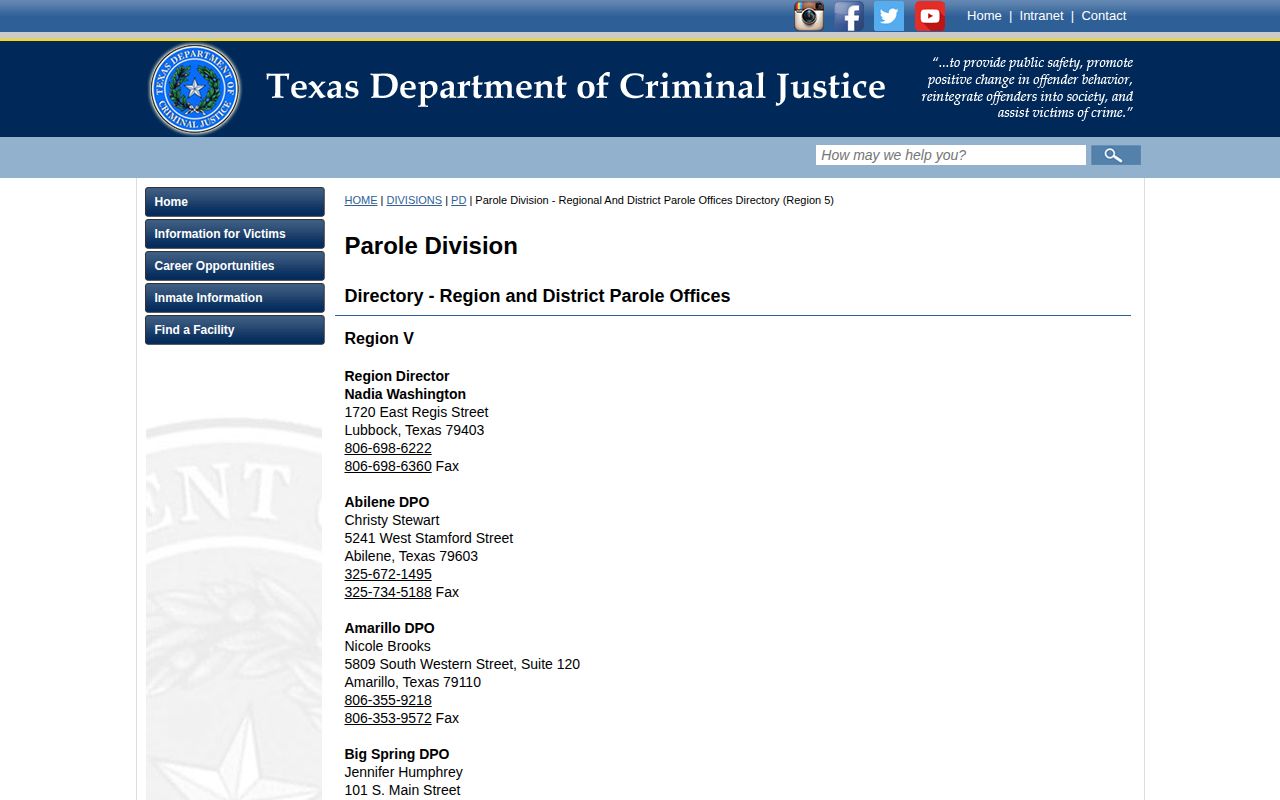
The captured directory gives the researched Lubbock office details, but the person's verified assignment remains the key fact.
Note: The research does not publish office hours, so call before traveling and do not assume the lobby schedule.
Yoakum Parole Review Records
Parole review is not a public courtroom-style hearing. The Board's panel-review explanation says members review and vote the file individually. There is no public calendar for ordinary person-specific reviews. Administrative open meetings are not inmate hearing dates. TDCJ identifies cases before an eligibility or later review point, an Institutional Parole Officer prepares a summary, and a three-member panel votes. Eligibility means review may be possible. It does not guarantee approval or release.
Before a vote, the published status number is 844-512-0461. After approval, Review and Release status is available at 512-406-5202. Have the TDCJ or SID number, or the exact date of birth. Approval codes may call for a future month, a program, or other steps. New case or disciplinary information can also affect an approval. Physical exit should be confirmed through the later release or supervision record, not the vote alone.
The official process provides a useful sequence, though not a guaranteed day. TDCJ identifies a case about six months before an initial eligibility date and about four months before a later review date. An Institutional Parole Officer interviews the prisoner and prepares the file summary. Two matching votes on the three-member panel decide the case; otherwise, the third vote resolves it. TDCJ Victim Services describes the full review as often taking about two to six months. Treat that span as an estimate. A denial notice can state the next review date, while an approval still may require release planning and satisfaction of other conditions.
The live Board voting-options page defines current codes such as approval, program-contingent, and denial outcomes. Those codes should be read from the source because rules and labels can change.
Yoakum Supervision Warrants
An absconder is a person alleged to have stopped reporting or otherwise left supervision without authorization. That status is not a release type. Someone may be outside a facility yet face a parole warrant or probation revocation action. Government Code Chapter 508 provides parole-warrant and revocation mechanisms. Probation violations appear through the sentencing court and its Chapter 42A process.
Different offices hold different pieces. The court docket may show a motion to revoke probation. TDCJ or the assigned parole office can address parole supervision. County warrant information may show a separate local process. No public-list result should be treated as proof that a warrant was cleared. When an official source reports an active warrant or absconder status, do not approach the person. Contact the responsible agency.
For state-prison and parole notices, TDCJ uses the Integrated Victim Services System. IVSS is separate from county VINELink and can provide notices tied to parole review, release to supervision, discharge, and some supervision-warrant actions. It does not replace the supervising office's record.
Yoakum Release Support Connections
The Yoakum County Sheriff's official page invites community partners to participate in its Community Connection Coalition. It names life skills, financial literacy, parenting classes, recovery-focused support, outreach, mentorship, and restoration for people currently in custody. That is a distinctive local connection. It should not be described as a guaranteed post-release benefit, a formal reentry program, or a service for every person on parole or probation.
The careful use of this information is modest. A person preparing to leave the Yoakum County Law Enforcement Center can ask the sheriff whether the coalition has a current contact or transition role. Someone already on supervision should ask the assigned officer about approved resources and any conditions that govern participation. The sheriff's Community Connection Coalition invitation is the source for the listed subjects, not proof of eligibility after release.
Yoakum Release Property Records
Post-release questions sometimes concern property left at booking rather than the terms of supervision. Texas State Library Local Schedule PS4200-12 gives inmate property inventories and receipts a minimum retention period of release or transfer plus two years. A person disputing whether property was returned may request the existing inventory and release receipt from the Yoakum County Sheriff's Office for the specific booking.
The property record is separate from parole, probation, and the permanent jail register. It does not prove why the person left custody or whether the criminal case ended. A signature or receipt may document the agency's transaction, while any correction or claim process must be obtained from the sheriff. The local retention schedule supports the paper trail, but the custodian decides what responsive record remains and what may be released.
Note: Ask for the booking property inventory and release receipt by name, booking date, and booking number when known.
Yoakum Supervision Discharge Proof
Supervision ends through a formal record. For probation, the signed court order is stronger proof than a name missing from an online entry. The order may show completion, early discharge, modification, or the result of a revocation matter. Use the official County Clerk or District Clerk path for the sentencing court and match the cause number. Community supervision is not presumed complete merely because its original end date passed.
For parole or mandatory supervision, ask TDCJ for the historical supervision and discharge record. The current inmate locator will no longer return a person once the individual is not incarcerated in a TDCJ facility. That limit does not reveal whether the person was paroled, fully discharged, transferred, died, or was affected by another record event. TDCJ's information channels or a written public-information request can address actual release type, discharge date, and office history. Under the Texas Public Information Act, request existing records and expect lawful redactions where applicable.
A discharge record closes the supervision question it addresses. It does not rewrite the court judgment, erase the case, or establish facts held by a different custodian. Keep the agency response with the court order so the full Yoakum County chronology remains clear.